
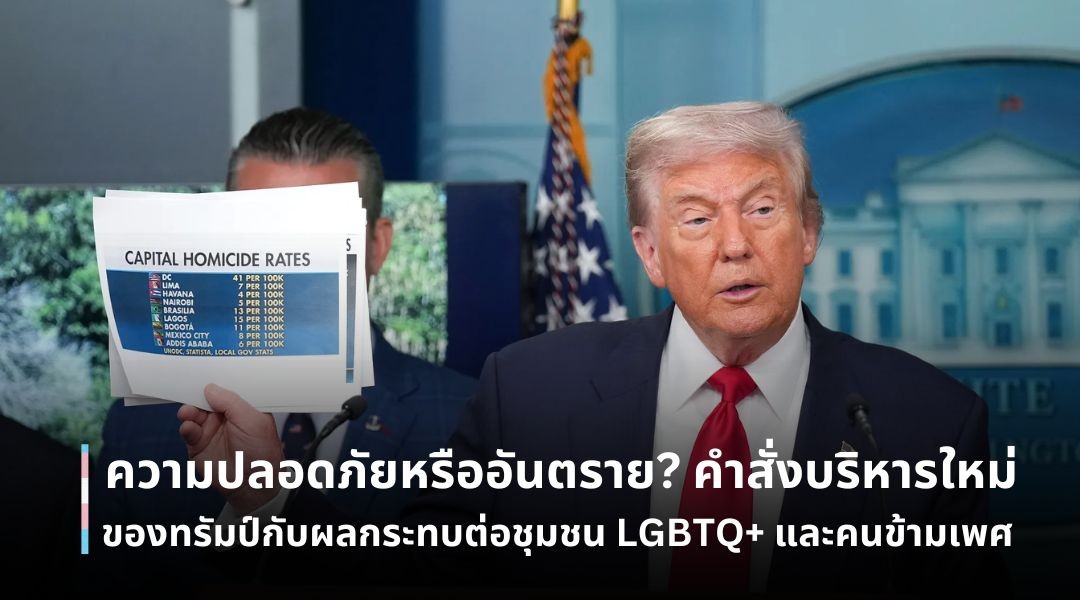
On July 24, 2025, President Donald Trump signed an executive order titled “Ending Crime and Disorder on America’s Streets.” While the White House framed it as a decisive step to restore “law and order” and protect public safety, human rights advocates, legal experts, and LGBTQ+ organizations see it as a troubling shift.
This order is not just a bureaucratic directive; it represents a policy turn toward punitive approaches over supportive care, with potentially devastating consequences for homeless populations, people with mental health conditions, and especially trans and LGBTQ+ people.
Core Provisions of the Executive Order
The EO expands federal and local authority to target what the administration describes as “disorder” in public spaces. Key measures include:
Prohibiting urban camping and unhoused encampments in cities
Expanding arrests for loitering, disorderly conduct, and vagrancy
Increasing use of civil commitment and involuntary outpatient treatment for people with mental health conditions
Redirecting federal grants away from housing-first and harm-reduction programs, which evidence shows to be effective, toward punitive enforcement-based initiatives
The language of “crime” and “disorder” echoes older “law and order” policies — emphasizing policing and incarceration over housing, healthcare, and community support.
From Care to Carcerality
Advocates warn that the EO represents a paradigm shift: from a “logic of care” to a “logic of carcerality.”
The housing-first model, widely recognized as an evidence-based solution to homelessness, prioritizes stable housing as the foundation for recovery and reintegration. Instead, Trump’s EO pushes for forced treatment and criminalization, echoing past eras when social problems were met with incarceration rather than investment in social services.
Jennifer Mathis, Deputy Director of the Bazelon Center for Mental Health Law, cautioned:
“These provisions about expanding civil commitments and involuntary outpatient commitments… all of that signals a shift away from evidence-based practices.”
Who Is Most at Risk? Trans and LGBTQ+ People
While the EO does not explicitly mention LGBTQ+ people, it poses particular risks to trans communities:
Disproportionate homelessness: Transgender people face homelessness at 2–3 times the rate of the general population, due to family rejection and workplace discrimination.
Mental health vulnerability: Higher rates of depression, PTSD, and suicidality put trans individuals at risk of being swept into involuntary treatment systems.
Dangerous language: The EO references “sexually dangerous persons” — a legal category for sex offenders. But anti-trans rhetoric has historically conflated trans identities with predatory behavior, labeling them as threats to children. This fuels fears that the EO could be weaponized to stigmatize and criminalize trans existence.
Political and Historical Context
This EO is part of a broader pattern in Trump-era policymaking:
2017–2020: Trump banned transgender people from military service.
Cut federal funding for LGBTQ+ research and public health initiatives.
Attempted to roll back nondiscrimination protections in shelters, bathrooms, and schools.
July 2025: Terminated LGBTQ+ youth–specific support on the 988 Suicide & Crisis Lifeline.
Seen together, these moves reflect a consistent agenda: erasing trans and LGBTQ+ people from public life, policy recognition, and protective systems.
Reactions from Advocates and Organizations
The EO has sparked strong pushback:
Shannon Minter, National Center for Lesbian Rights:
“This executive order is a direct assault on vulnerable people who deserve care and support, not forced institutionalization.”
Tom Murphy, National Alliance to End Homelessness:
“This stigmatizes people for their homelessness and fails to address root causes.”
Bethany House, a homelessness nonprofit in Laredo, Texas, warned that the EO could endanger women fleeing domestic violence, leaving them with no options beyond forced institutionalization.
Social Consequences
If fully enforced, the EO could lead to:
Mass arrests of unhoused people, worsening overcrowded prisons
Involuntary psychiatric commitments, raising human rights concerns
Chilling effects on LGBTQ+ communities, who may avoid seeking help for fear of being criminalized
Erosion of trust in public health and social services, as vulnerable groups associate care with coercion
Human Rights Perspective
International legal experts note that the EO may violate U.S. obligations under treaties such as the International Covenant on Civil and Political Rights (ICCPR) and the International Covenant on Economic, Social and Cultural Rights (ICESCR) — which protect against arbitrary detention and guarantee the right to housing and healthcare.
Lessons from the “War on Drugs”
Critics draw parallels between this EO and the War on Drugs of the 1980s–1990s, which prioritized policing and incarceration over treatment. That approach led to mass incarceration, systemic racial inequities, and little progress in addressing addiction. Trump’s EO risks repeating the same mistakes, only this time targeting homelessness and mental health under the banner of “crime control.”
Conclusion: Why LGBTQ+ Communities Must Stay Alert
This executive order is more than a homelessness policy — it represents a broader rollback of LGBTQ+ rights and civil liberties.
It could criminalize trans bodies and identities by tying them to “disorder” and “danger.”
It abandons evidence-based public health strategies, replacing them with coercion and punishment.
It fits into a wider political project of erasing LGBTQ+ people from visibility and protection.
For trans and LGBTQ+ communities, this EO is a warning sign: safety cannot come at the expense of human rights. Advocates stress that real solutions require housing, healthcare, and inclusion — not fear, stigma, and incarceration.
Sources and further reading
Primary and authoritative sources used for context and fact-checking.
- Frequently asked questions on sexual and gender diversity, health and human rights World Health Organization (WHO)
- The Thai Handbook of Transgender Healthcare Services IHRI & Center of Excellence in Transgender Health, Chulalongkorn University
- Standards of Care for the Health of Transgender and Gender Diverse People, Version 8 World Professional Association for Transgender Health (WPATH)
- Consolidated guidelines on HIV, viral hepatitis and STI for key populations (2022) World Health Organization (WHO)
- STI Treatment Guidelines: Transgender and Gender Diverse Persons U.S. Centers for Disease Control and Prevention (CDC)
- Legal Gender Recognition in Thailand: A Legal and Policy Review United Nations Development Programme (UNDP)
- The struggle of trans and gender-diverse persons United Nations Human Rights (OHCHR)