

“Before, we were deciding which country to register our marriage in that legalized same-sex marriage. When we heard that Thailand was going to allow same-sex marriage… it was perfect!” After saying that, Russian Ksenia snapped her fingers and smiled in satisfaction as she told Spotlight why she and her wife decided to cross the ocean from Russia and choose Thailand as the place to register their marriage to officially start their life together.

Kesenia and Elena are Russians who have been living in Pattaya for 8 months. Having fallen in love with the weather and food of Thailand and having traveled there many times before, they decided to do business in this seaside city where there are many Russians. This past Thursday, January 23, the couple traveled to Bangkok to register their marriage at “Marriage Equality” held at Paragon Hall with a group of friends who came to witness their love.
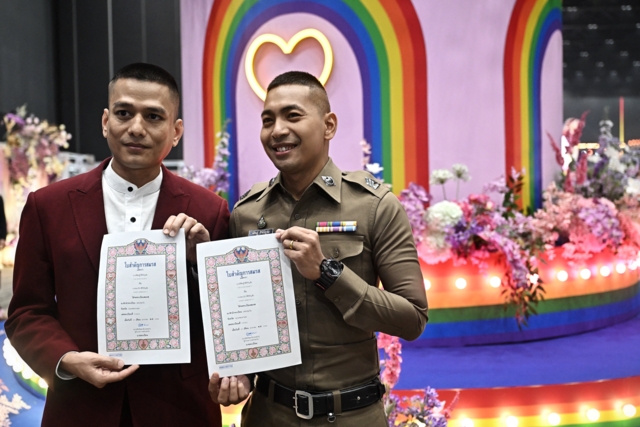
January 23, 2025, is a historic day for Thailand, as the country's human rights movement has taken another step forward, as it is the first day that marriage equality has become legal, according to the Civil and Commercial Code Amendment Act (No. 24) B.E. 2567. The atmosphere in districts across the country is filled with LGBTQ couples who have come to register their marriages, along with friends and relatives who came to celebrate. There were 2,799 couples nationwide who registered, of which 1,839 were same-sex couples, and 185 couples who came to register at the marriage equality event at Siam Paragon, where the government sent a team to facilitate at this shopping mall.
Among these couples, there were quite a few, one of whom was a foreigner and the other was Thai, such as Singaporean couple Nopparat Devamat and Peter Basil De Souza, who have been dating and living together for 22 years. The couple decided to register their marriage at Siam Paragon as well, and chose to register on the first day that the law allowed it to be a part of history. When asked how they felt about changing their legal status from single to married, the couple felt very happy and touched. Because I never thought this day would come. And there is another feeling, which is “more peace of mind.”
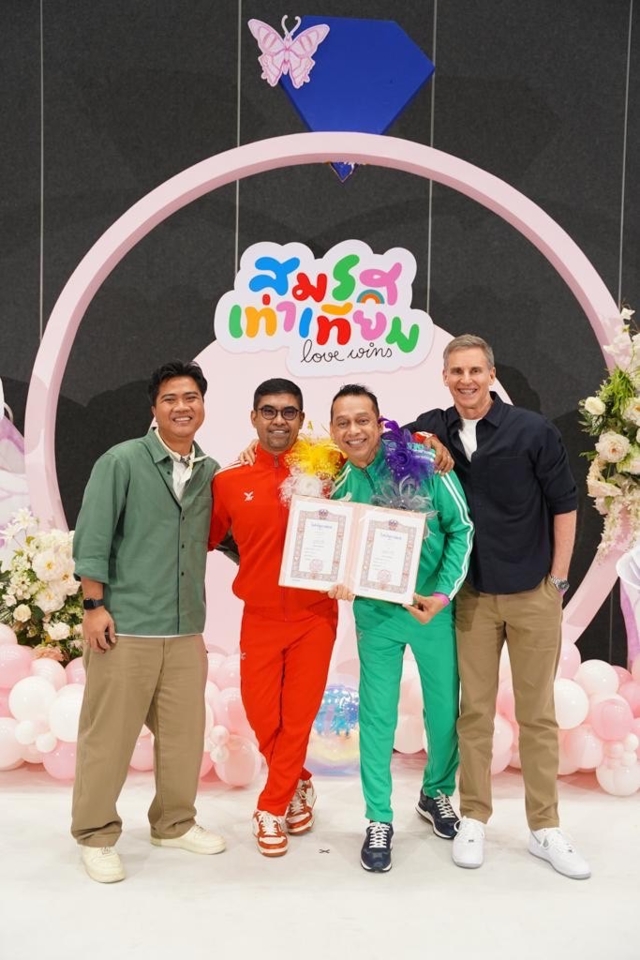
“We will be worried that if something happens to him, will we have the right to make medical decisions for him? Or if something happens to the other person, what will happen to our joint inheritance assets? And before this, I also bought a condo, so there were problems with the documents. We always encountered various complications with the documents. Today, I feel more peace of mind that we are legally married,” said Mr. Nopparat before taking a photo with the marriage certificate with foreign friends who came to sign as witnesses for the couple and walking the rainbow red carpet parade with leading Thai celebrities from all industries.
The path of “equal marriage” that still needs to be fought on the international stage
When asked about the marriage registration process today, were there any problems or obstacles? For Mr. Nopparat and Mr. Peter, they felt that the process on the day of registration at Siam Paragon was fast, taking less than 15 minutes to submit documents, fill in information and sign documents until all steps were completed. But the most difficult part of the marriage registration process for the couple was preparing the documents on Mr. Peter’s side, especially the certificate of status for marriage with a foreigner, which must be submitted from the Singaporean Embassy.
“The really difficult step was requesting the documents from the Singaporean Embassy because Singaporean law does not yet recognize same-sex marriage. I must say that we have been preparing the documents since October of last year, which is about 3-4 months. And we just received the documents from the embassy a few days ago. We were anxious and called to follow up. But we have to thank the embassy for facilitating us until we were able to submit the documents today.”
Although the path of fighting for equal marriage laws in Thailand has taken more than 10 years since the first draft of the Civil Partnership Act During the time of former Prime Minister Yingluck Shinawatra in 2013, it was considered one of the top countries that made the most progress in accepting sexual diversity in the Southeast Asian region. This is because Thailand is the third country in Asia and the first country in ASEAN to have a marriage equality law. While Singapore has also moved in a better direction. The Singaporean parliament repealed the law that criminalized gay sex in 2022.
This unequal intensity of sexual diversity rights is one of the obstacles for foreign LGBTQ couples who want to register their marriage in Thailand. This is consistent with information from Ms. Jitwipa Benjasil, Director of the Social Division, Department of International Organizations, who said in the seminar "Checking readiness: Marriage equality and moving forward" that some countries still have laws that punish people on the basis of their gender or discriminate.
However, Ms. Jitwipa revealed that the progress in Thailand, which passed the marriage equality law last year, has created a leading role in driving rights and freedoms on the international stage. Thailand is the first country in Asia to be in the Equal Rights Coalition (ERC) on the United Nations' multilateral platform, which protects and promotes the rights of the LGBTQIA+ group. In addition, government agencies In particular, the Ministry of Foreign Affairs and various embassies are ready to facilitate all international LGBTQ couples who wish to register their marriage in Thailand.

The law passed because Thai society is ready.
Ksenia and Elena are both foreigners who traveled from Russia. Although one of them is not Thai, the law allows them to get married in this country. Compared to the laws and society of Russia, this place should allow them to express their love for each other more openly and comfortably than in their home country. The AP news agency reported that the Russian government passed a law banning "propaganda of non-traditional sexual relationships" in 2022, making LGBTQ+ activities in public illegal. In the same year, a same-sex couple was arrested for demonstrating against the discriminatory law.
In addition to Thai law allowing Ksenia and Elena to be life partners, Thai society is also accepting and ready to provide assistance. Most foreign couples who come to register have one Thai partner, so they can communicate and translate easily with the officers. However, this Russian couple did not have an interpreter with them and could not read or write Thai. Fortunately, Ms. Prempreeya Pramoj, a researcher and gender equality activist, and her friends were willing to attend today's event to volunteer to help sign as witnesses for couples who did not have friends or relatives with them. And she became a volunteer interpreter, translating between couples and officials, making their registration today much easier.

The above small stories reflect that Thai society accepts and supports sexual diversity. Ms. Nareeluck Paechaiyaphum, Director of the International Human Rights Division, Department of Protection and Liberties, believes that Thai society is more accepting of sexual diversity compared to 15 years ago. Most Thais have knowledge and understanding and see the importance of non-discrimination. Plus, the government has given the green light to the process of amending the law and the private sector is ready to adjust itself to LGBTQ rights in organizations, especially in providing various welfare benefits. When all sectors look in the same direction like this, today Thailand finally has a “marriage equality law.”
CR.amarintv
Sources and further reading
Primary and authoritative sources used for context and fact-checking.
- Frequently asked questions on sexual and gender diversity, health and human rights World Health Organization (WHO)
- The Thai Handbook of Transgender Healthcare Services IHRI & Center of Excellence in Transgender Health, Chulalongkorn University
- Standards of Care for the Health of Transgender and Gender Diverse People, Version 8 World Professional Association for Transgender Health (WPATH)
- Consolidated guidelines on HIV, viral hepatitis and STI for key populations (2022) World Health Organization (WHO)
- STI Treatment Guidelines: Transgender and Gender Diverse Persons U.S. Centers for Disease Control and Prevention (CDC)
- Legal Gender Recognition in Thailand: A Legal and Policy Review United Nations Development Programme (UNDP)
- The struggle of trans and gender-diverse persons United Nations Human Rights (OHCHR)