
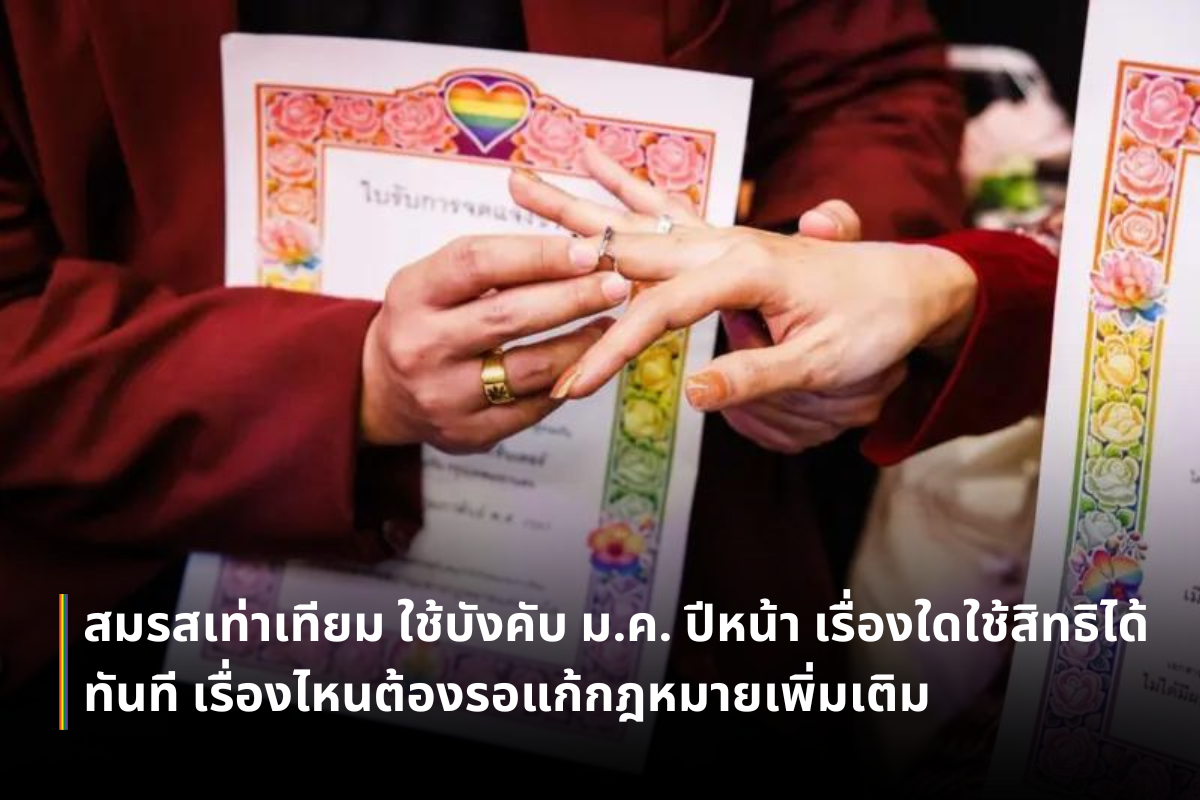
It has been nine months since the Thai House of Representatives first read the Marriage Equality Act.
On September 24, the Civil and Commercial Code Amendment Act (No. 24) B.E. 2567 was published in the Royal Gazette, and will come into effect in 120 days, or January 22, 2568.
This Marriage Equality Act not only grants rights to LGBTQI+ persons, but also comes with duties as spouses. Many rights and duties will immediately follow the rights that spouses receive under other laws. In some cases, even though marriage registration is already possible, other laws must be amended to comply.
As marriage equality registration becomes a reality early next year, BBC Thai explores the rights that LGBTQI+ couples will receive under this law.
Rights and duties that come into effect immediately When the Marriage Equality Act is enforced
- Engagement - Engagement can be done only when both parties are 18 years of age (Section 1435)
- Marriage - Marriage can be done only when both parties are 18 years of age, but in case of reasonable cause, the court may allow the marriage to be done before that (Section 1448)
- Marriage registration - Marriage can be done only when two people agree to be spouses and must show such consent publicly before the registrar and have the registrar record such consent (Section 1458)
- Divorce - When the marriage is registered according to this Code, divorce by consent will be complete only when the spouses have registered the divorce (Section 1515)
- Management of property between spouses that are jointly earned or take care of the benefits from the property and manage debts together
- Right to receive benefits and welfare from the state as spouses
- Giving consent to medical treatment
- Being a guardian or guardian in the case that the court orders one spouse to be incompetent or quasi-incompetent (Section 1463)
- Maintenance of spouses - Maintenance between spouses Or between parents and children, it can be called apart when the party who should receive care does not receive care or receives care that is insufficient for their ability (Section 1598/38)
- Joint adoption as a spouse, exercise rights under the Civil Code in the section on child adoption

Joint adoption immediately
Under the Marriage Equality Act or the new Civil and Commercial Code, LGBTQI+ couples who are registered under this law can adopt children together according to the existing adoption law, which is the Civil Code, Chapter 4 on adopted children.
Regarding this matter, Naiyana Supaphueng, a member of the Special Committee on the Consideration of the Marriage Equality Act, explained at the seminar "Preparing Thailand for Marriage Equality Law" on September 20 that even before the Marriage Equality Law, LGBTQI+ persons could adopt children, but the right to adopt children together of same-sex couples could not. But as soon as the Marriage Equality Law was in place, both couples could legally adopt children together.
"The old law said that “An adopted child must be the child of one person, but if they are registered as married, they can adopt together,” said Naiyana.
This means that before the Marriage Equality Act, LGBT couples, even though they formed a family, did not have the legal status of spouses. Therefore, they could not legally adopt children. But when the Marriage Equality Act came into effect, spouses of any gender were able to adopt minors together according to the Civil and Commercial Code Section 1598/26 immediately, which allows joint adoption of minors only in cases where the spouse of the adoptive parent adopts the other spouse’s adopted child as their own.

Marriage registration with a foreigner is possible immediately, but obtaining citizenship based on the spouse’s status still has to wait for the law to be amended.
In the same seminar, Naiyana said that a popular question that has been asked recently is whether the Marriage Equality Act can be applied to foreigners.
The answer is “yes,” but there are still conditions for spouses to obtain Thai citizenship that cannot be done immediately because the Nationality Act only specifies the case of a foreign wife who wishes to apply for citizenship based on her husband, which will require amendments to this law.
Obtaining Thai nationality According to the Nationality Act of 1965, Section 9 states that in the case where a wife wishes to apply for Thai nationality following her husband, she must have been legally married to a Thai man for no less than 3 years as of the date of application. There is also a provision in Section 10 that those applying for nationality must have knowledge of the Thai language, by being able to speak and understand Thai.
Naina pointed out that this is a trace of a status that has been discriminated against based on gender, not just LGBTQI+, but also includes discrimination between men and women that has been around for a long time because the Civil Code was written in the context of a society in the past that valued gender differently.
The committee that drafted this law stated that if the Marriage Equality Act comes into effect, the word “spouse” will cover all genders and it is expected that the conditions in this nationality law will be amended as well.
“As soon as the word spouse changes, the nationality law must change, which will benefit men and women as well,” Naina said, adding that this law has a time frame in which various government agencies must notify the Cabinet to review and amend it within 180 days.

There are still children born through IVF from exercising their rights under the law on children born from reproductive technology that cannot be done.
Previously, while the House of Representatives and the Senate Considering the Marriage Equality Bill Another important issue that the Drafting Law Committee sees as an obstacle to same-sex couples being able to have and exercise the right to establish a family equally with heterosexual couples is the Protection of Children Born from Assisted Reproductive Technology Act B.E.2015
Chatchai Emraj, a lawyer and advisor to the House of Representatives’ Special Committee on Marriage Equality Bill, previously told the BBC Thai that the text in the Act on the Protection of Children Born Through Assisted Reproductive Technology, which applies only to those who cannot have biological children together naturally, still attaches itself to being a man and a woman and the status of being husband and wife due to the legal and social context at the time the bill was drafted, which was written in several sections of the law, such as:
- Section 19 stipulates that artificial insemination must be performed on “women with legal husbands.”
- Section 21 stipulates an important condition for surrogate pregnancy that it must be performed by “legal husbands and wives.”
“These sections were not amended in the Marriage Equality Bill, and may be a significant obstacle for couples under the Marriage Equality Act who do not have the status of “husband” and “wife” in accessing medical reproductive technology services, which is currently the only channel that can allow same-sex couples to have a family.”
For the progress of amending this law, the working group of the Ministry of Social Development and Human Security is in the process of drafting the amendment.
There are many more rights and duties of spouses under this new law, which Section 67 of this draft bill also reads: "All provisions of laws, rules, regulations, regulations, stipulations, announcements, orders, or Cabinet resolutions that refer to husbands, wives, or husbands and wives shall be deemed to refer to spouses who are registered as married under the Civil and Commercial Code as amended by this Act."
Cr:bbc
Sources and further reading
Primary and authoritative sources used for context and fact-checking.
- Frequently asked questions on sexual and gender diversity, health and human rights World Health Organization (WHO)
- The Thai Handbook of Transgender Healthcare Services IHRI & Center of Excellence in Transgender Health, Chulalongkorn University
- Standards of Care for the Health of Transgender and Gender Diverse People, Version 8 World Professional Association for Transgender Health (WPATH)
- Consolidated guidelines on HIV, viral hepatitis and STI for key populations (2022) World Health Organization (WHO)
- STI Treatment Guidelines: Transgender and Gender Diverse Persons U.S. Centers for Disease Control and Prevention (CDC)
- Legal Gender Recognition in Thailand: A Legal and Policy Review United Nations Development Programme (UNDP)
- The struggle of trans and gender-diverse persons United Nations Human Rights (OHCHR)