
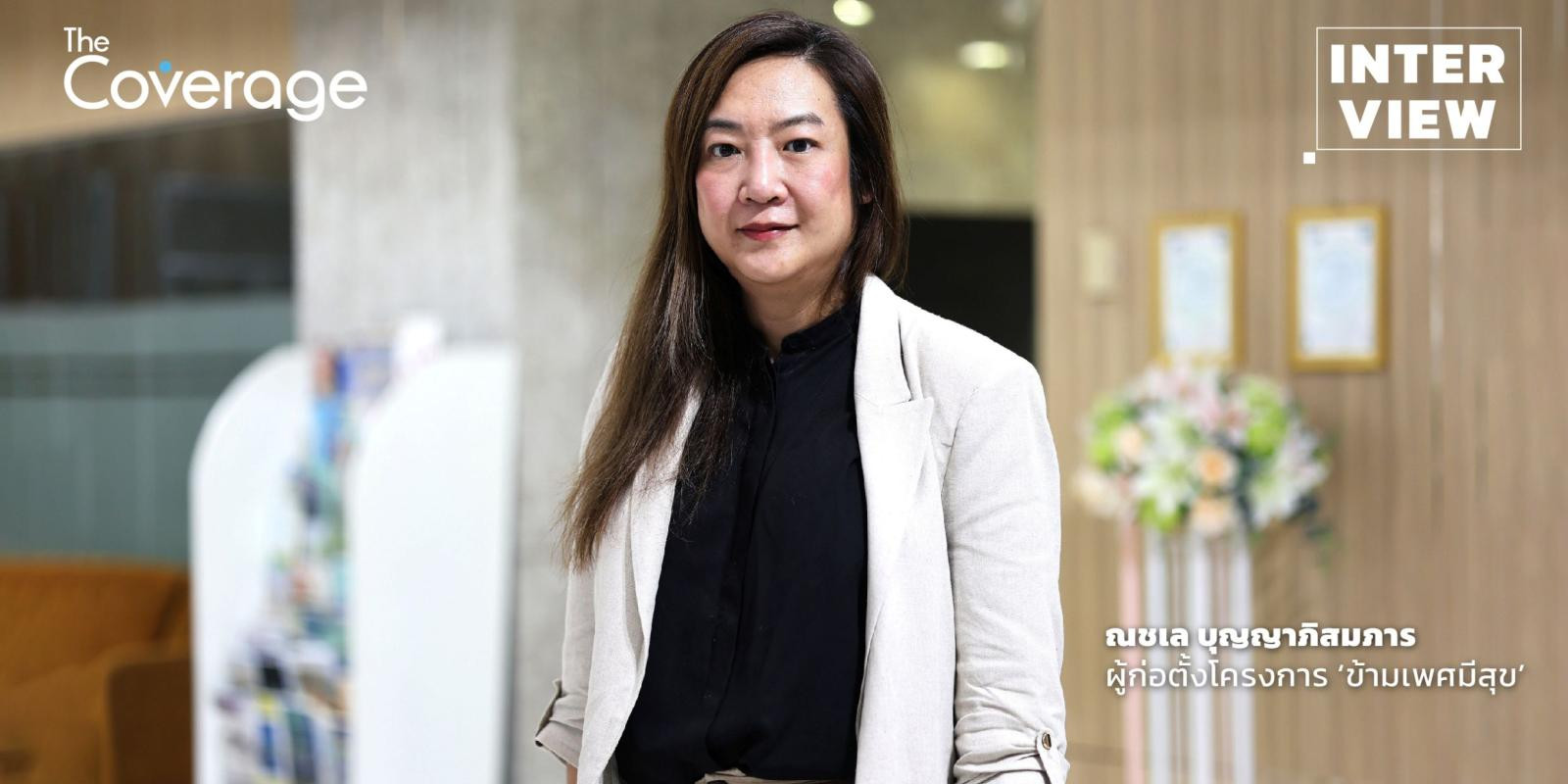
For over 10 years, Natchale Bunyaphisombat, or Hua, a ‘transgender woman’ from Phrae Province, has been living in the United States as a ‘woman’ who is entitled to various health benefits provided by the government. After flying there in 2010, Natchale flew to study there.
After completing her master’s degree, Natchale also had the opportunity to work for Apicha Community Health Center, a community health center in Manhattan that provides services to low-income people who do not have health insurance or who do not legally reside in the United States, including providing various services to transgender people, such as receiving hormone pills or counseling.
These things, whether it is her personal life story or her work experiences, have shaped her into an activist for transgender rights ever since.

In 2020, Natchale decided to return to her home country while the world was in turmoil with the COVID-19 pandemic. When she arrived, she found that although Thailand had many transgender organizations providing health services, especially for sexually transmitted diseases (HIV), the burden of responsibility was so much that it could be called “work overload.” Natchale felt that she wanted to help push for more welfare related to transgender health.
Therefore, in the following year, she founded and began to be responsible for the Transgender Health Service Policy Mechanism Development Project (T-HAT) or the “Transgender Happiness” project, which received funding support from the Health Promotion Foundation (ThaiHealth).
Natchale’s project will focus on and push the process through 3 main parts: 1. Working for the transgender community by helping to develop their potential; 2. Creating a space for transgender people to express their needs; and 3. Reflecting the obstacles in accessing transgender-related health services.
Pushing for health rights through a synergistic mechanism
However, pushing for transgender health rights It cannot be achieved through tangible results from civil society movements alone. It must work together with other sectors, including government agencies and the private sector, as well as disseminating information to the public through various media channels in order to use the demands and needs of transgender people to drive policy changes.

Therefore, Natchale, as the person in charge of the Transgender Happiness Project, must work together with organizations related to various health systems, such as the Ministry of Public Health (MOPH), the National Health Security Office (NHSO), or the National Health Commission Office (NHSO), etc.
The first success that has begun to be seen in concrete form is that government agencies have realized the importance of health services and access to hormone drugs for transgender people in Thailand. The NHSO has allocated a budget to support a new benefit service, namely “Health services for transgender people”, in the amount of 145.63 million baht to take care of a target group of 200,000 people and has promised to try to push for it to become a set of benefits in the national health insurance system (Gold Card) by 2025.
Currently, this push is in the process of setting guidelines for providing hormone drugs for gender confirmation (Guideline) to be used as a service standard, which the Royal College of Obstetricians and Gynecologists has assigned to use the guidelines developed by the Thai-PATH Association as the main method of operation, which must go through the process and consideration steps from the relevant royal colleges in sequence.

“Thai-PATH will expedite the preparation of the guidelines, including the preparation of the guidelines for disbursement of benefits (Protocol) in collaboration with the NHSO as soon as possible. After the preparation of the guidelines is complete, the content must be submitted to the relevant royal colleges, such as the Royal College of Obstetricians and Gynecologists, the Royal College of Surgeons, the Royal College of Psychiatrists, etc., to provide opinions and provide certification,” said Natchale.
However, despite this success being a welcome achievement, there are still many other areas that need to be driven in parallel to ensure that all transgender people in Thailand will have access to the hormone drug benefit package.
“If the country can really push for this to happen, we will be one of the first countries in Asia to prioritize the health of transgender people,” she said.
Equal marriage is not a ‘magic pill’

Natchale admitted that the passage of the Civil and Commercial Code Amendment Act (No. 24) B.E. 2567 or the Marriage Equality Act, which officially came into effect on January 23, 2568, was a ‘dream come true’.
She said with a tone of delight that these things have really happened in our country. Their first dream has come true. However, the movement for equality for LGBTQ and transgender people has not ended.
“I must say that equal marriage is not a magic pill. It may not change society in a single day. But the fact that we started with the passage of the Marriage Equality Act has given people more space to talk about the rights of LGBTQ people. At present, and in the future, we will not only talk about gender equality between men and women, but also gender equality,” Natchale said.
She elaborated that there are about 2–3 issues that should be pushed forward: using the correct terminology for LGBTQ people, both in academic and educational circles, including the use of legal language, or the right to access reproductive technology, pregnancy through surrogacy. Previously, this was a legal restriction that prevented same-sex couples from having children. The result of the passage of the Marriage Equality Act will be an important part in opening opportunities for LGBTQ people to access surrogacy technology to have children.

Second, this marriage equality law does not yet support people with gender identities that are different from their birth gender. For example, if one day a transgender woman gets married and registers her marriage, legally a transgender woman who registers her marriage is the husband, not the wife. These details have not been resolved, which is something that needs to be worked on further to drive the law to recognize gender identity.
However, the fight for a law that recognizes gender identity in Thailand is not new. Natchale said that as someone who has been following and campaigning for transgender rights, she has heard about the law changing titles since 2007. That means it has been at least 18 years since people started talking about this issue in society.
“Therefore, now that the first door has been opened with the marriage equality law, I sincerely hope that society will move forward together again. Right now, there are 4 draft bills to push for a law to recognize gender identity or titles waiting to be considered in parliament. I hope that parliament will open up an opportunity for the public to participate in driving the said law,” Natchale said.
Trump’s policies affect transgender people in America
As Natchale has lived in America for many years, Therefore, we cannot help but question how much the policies of the new president, Donald Trump, will affect transgender people living in America.
“From what I have been following in the news, there will definitely be several special orders from the president that will affect transgender people,” she said.
The first is the order that prohibits providers from providing hormone therapy and gender confirmation surgery to children and youth under the age of 19, which were previously allowed to receive services, but only with parental consent. Another policy that will have an impact is the president stating that there are only two genders: male and female, and stating that all government employees who perform official duties must use the word “sex”, not “gender”, in their policies and documents.

She elaborated that with the status of the United States as a large country with influence on many civilized countries, any change in policy will affect people all over the world in one way or another. The worrying thing is that when the United States takes this direction, it will become a model for other countries, causing executives and policy makers to use the United States as a reason to stop supporting services for transgender people.
“For Thailand, I personally think that if we want to be a country that develops equality for people in society, we shouldn’t be afraid to be a good example. We don’t need to use examples from abroad. If we think that we care and are firm in our choices, that the country should move towards gender equality, equality for people in society, then we should be an example for other countries if we are confident that this is the right thing to do,” said Natchale.
Therefore, for the determination to continue to drive what is right for Thai society, at the end of the conversation, she did not forget to invite agencies, organizations, or people who are interested in the issue of gender diversity to join the National Conference: Transgender Health. (Transgender Happiness) 2nd time at Miracle Grand Convention Hotel, Bangkok on 31 March – 1 April 2025, which is an event in collaboration with 29 network partners nationwide to discuss and exchange information about the situation of transgender people in Thailand.
“This will be one of the events that attract the most transgender network members, which will be an opportunity for all parties to learn and understand each other.”

CR.thecoverage
Sources and further reading
Primary and authoritative sources used for context and fact-checking.
- Frequently asked questions on sexual and gender diversity, health and human rights World Health Organization (WHO)
- The Thai Handbook of Transgender Healthcare Services IHRI & Center of Excellence in Transgender Health, Chulalongkorn University
- Standards of Care for the Health of Transgender and Gender Diverse People, Version 8 World Professional Association for Transgender Health (WPATH)
- Consolidated guidelines on HIV, viral hepatitis and STI for key populations (2022) World Health Organization (WHO)
- STI Treatment Guidelines: Transgender and Gender Diverse Persons U.S. Centers for Disease Control and Prevention (CDC)
- Legal Gender Recognition in Thailand: A Legal and Policy Review United Nations Development Programme (UNDP)
- The struggle of trans and gender-diverse persons United Nations Human Rights (OHCHR)