
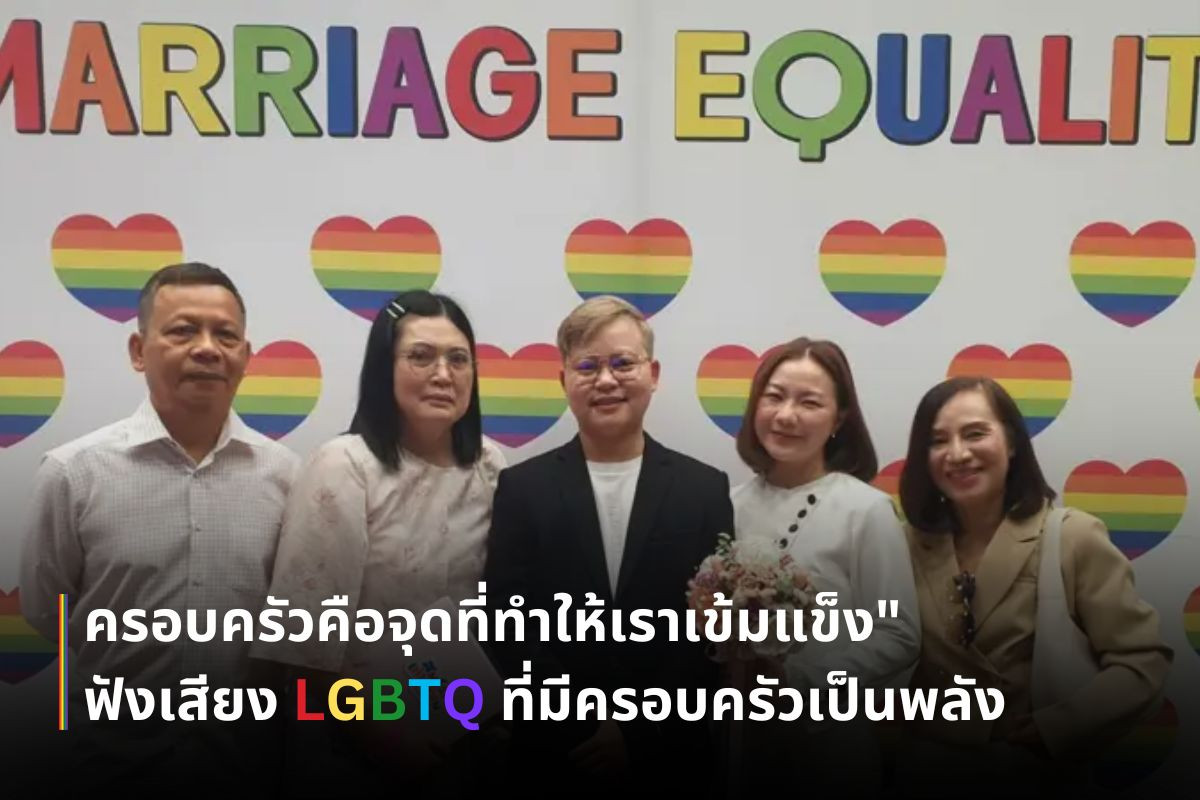
Marriage equality law was officially enforced in Thailand for the first time on January 23. On that day, 2,799 same-sex couples registered their marriages nationwide, with 661 in Bangkok alone. This was a huge celebration of the enforcement of marriage equality law in Thailand.
At the "Marriage Equality" event held at Siam Paragon yesterday, Prime Minister Paetongtarn Shinawatra sent a video message to congratulate the couples. She thanked everyone involved in pushing for this law to be successful, including the LGBT community who "fight prejudice" and made Thai society "truly accept LGBTQ diversity with all their hearts."
At the event, it was not only LGBTQ couples who came to celebrate, but also their families and friends who came to congratulate the couples who registered their marriages.
BBC Thai spoke to several couples about their feelings and reasons why being accepted by their family is important, including opening up to LGBTQ people who have experienced discrimination from their family members.
"Family is the point that makes us strong."
At the same-sex marriage event held at Siam Paragon, 185 couples registered their marriages. One of them is Pawan Aiemwet, a 35-year-old lesbian who decided to register her marriage with her girlfriend, Kamonchanok Chumruen, who is 2 years older than her. Pawan's father and both of their mothers also traveled to witness this love ceremony.
Pawan and Kamonchanok have been together for more than 8 years. They have not hidden their identities from their families, which may be different from some LGBTQ couples who have to be careful about dating because their families do not accept them. Both were very happy when the day came when they were able to register their marriage. They had to go through many challenges to get to this day, but what made Pawan confident in living together as a couple was the support she received from her family.
"Family is what makes us strong. It can help us get through the hardships of the outside society. We live together as a family. Everything, every problem, we do it together as a family," said Pawan.
At the same time, Suwiphol Aiemwet, Pawan's father, aged 65, also came to witness his daughter's marriage registration because he believes that no matter what her gender is, Pawan will be able to live a happy life.
"The happiness of parents is the happiness of children. So if the child thinks that a path is happy, parents want them to follow that path. They will not obstruct it," Suwiphol told BBC Thai.

Kamolchanok's mother also came to congratulate the couple with a smile. Although she was shy and admitted that she was not very good at speaking, she explained the happiness of being a mother when her daughter married the person she loved.
"It doesn't have to be a man or anything. As long as they love each other, I'm happy," said Kamolchanok's mother.
However, not all genderqueer people receive such acceptance from their families.
"Is being ourselves really that sinful and bad?"
Nathineethi Phinyaphinchan, founder of Transtalent, a consultancy for creating workplaces that are friendly to gender diversity, is one of the transgender women who experienced gender identity rejection from her family, which she still remembers very well to this day.
She told BBC Thai about her childhood experience, in which a teacher at school called her parents in and reported to them that she had "gender-bending behavior" that was unacceptable to her family, and that she wanted to change Natthineethi to a man. So she was sent to study at the military academy.
"Actually, it was a reform school. I was sent there, and I felt that being myself was so sinful and bad. Why would they (the family) want to change who I am?" she said.
Nathineethithi also said that being sent to the military academy caused her great suffering, both physically, where she had to be trained to be strong, and mentally, because she didn't have many friends because she didn't fit in. She was also verbally abused by her father and mother, which was like a "scar in her heart." Not being able to get along with her friends at school and the family's lack of understanding of her gender identity made Natthineethithi feel like she didn't fit into any particular social group.
"I didn't know whether to join the women's or men's group. Men played football, and women played father-and-child. I felt like I didn't belong there anymore. I didn't feel like I could fit into any group. My family didn't understand this," she said.
Asst. Prof. Dr. Purin Naksingh, a lecturer at the Department of Sociology and Anthropology, Faculty of Social Sciences, Kasetsart University, gave his opinion on the matter to BBC Thai, saying that people of some generations may be less accepting of sexual diversity than younger generations. This may be due to accumulated beliefs, such as the view that there are only men and women in traditional genders to create a family, or that there must be heirs to continue the family line. Therefore, if family members hold the above beliefs, it may affect family members with diverse genders.
"A group of people from a certain era may have a harder time accepting gender diversity than the next generation, such as our grandparents, which has a greater or lesser effect on relationships and expressions of gender diversity."

"Family" Acceptance starts from the smallest unit
What Natineethithi thinks is important if Thailand wants to be a paradise for LGBTQ people is to start from the smallest unit, which is the "family". She believes that families should have a better understanding of LGBTQ diversity, whether through education or media. For her, media is the main thing that influences decisions about values and values in society.
"Media is an important part that determines the appearance or values of society, the ethics and morality of the media, and educational institutions should help create understanding in the small unit, which is the family. All sectors must work and integrate," she said.
Asst. Prof. Dr. Purin compared the case of equal marriage and acceptance of LGBTQ people in Thailand to Taiwan, which has announced a law on equal marriage since 2019. He said that even though Taiwan has announced such a law, if society, especially families, still do not understand LGBTQ diversity, problems may follow.
"Taiwan has equal marriage, but after registering for a short time, some couples divorced. Part of the reason is because the family did not accept it."
The academic from Kasetsart University also stated that in the past, LGBTQ diversity, no matter what it was called, was considered a sexual deviation. But now society is trying to point out that these things are tastes and not seen as deviations. Children will be instilled in this way, which will lead to wider acceptance in the future.
Kamolchanok's mother also mentioned her acceptance of her daughter's sexual diversity, saying:
"Love doesn't have to be opposite genders. Anyone can love each other because love is beautiful. Be happy, love and understand each other. Just this will make people around you happy."
CR.BBC
Sources and further reading
Primary and authoritative sources used for context and fact-checking.
- Frequently asked questions on sexual and gender diversity, health and human rights World Health Organization (WHO)
- The Thai Handbook of Transgender Healthcare Services IHRI & Center of Excellence in Transgender Health, Chulalongkorn University
- Standards of Care for the Health of Transgender and Gender Diverse People, Version 8 World Professional Association for Transgender Health (WPATH)
- Consolidated guidelines on HIV, viral hepatitis and STI for key populations (2022) World Health Organization (WHO)
- STI Treatment Guidelines: Transgender and Gender Diverse Persons U.S. Centers for Disease Control and Prevention (CDC)
- Legal Gender Recognition in Thailand: A Legal and Policy Review United Nations Development Programme (UNDP)
- The struggle of trans and gender-diverse persons United Nations Human Rights (OHCHR)